John Gerrard’s Three Flags, Artistic Judgement and the Unsettled Value of Digital Art
On Artistic Judgement and the Emerging Aesthetics of Digital Art
At Art Basel 2026, Zero 10 made its first appearance in Basel. Dedicated to art of the digital era, the sector brought together twenty exhibitors in the Event Hall at Messe Basel under the curatorial direction of Eli Scheinman and Trevor Paglen. Its arrival at the fair’s Swiss edition marked another step in the relationship between digital artistic practices and the established contemporary art world.
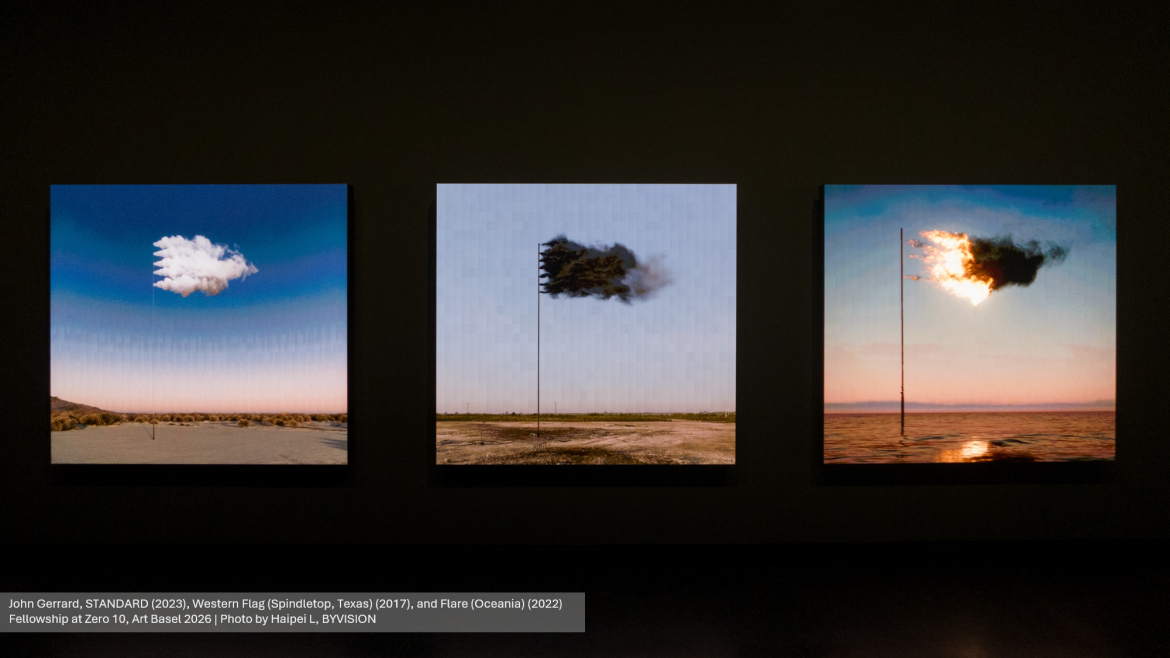
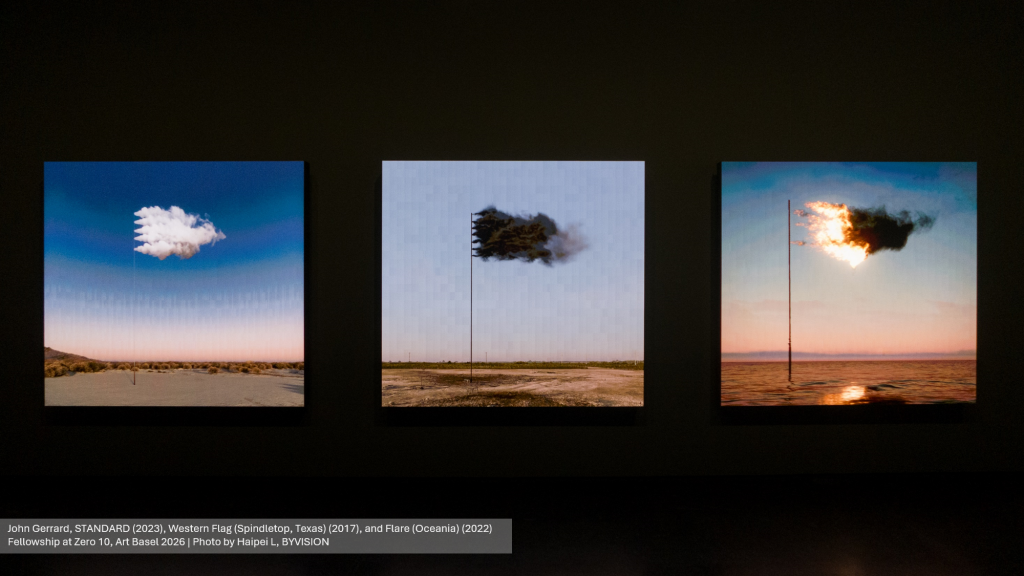
At the entrance, three works by Irish artist John Gerrard offered a remarkably assured introduction. Presented together by Fellowship, Western Flag (Spindletop, Texas) (2017), Flare (Oceania) (2022) and STANDARD (2023) formed one of the most compelling presentations of the exhibition.
Three flags occupied three quiet landscapes. One was made of black smoke, another of flame, the third of white vapour. They moved continuously above distant horizons, each following its own peculiar rhythm.
The arrangement possessed an immediate beauty. Each landscape was held by a low horizon and a slender flagpole. The surrounding emptiness gave the moving forms an unusual presence. Smoke gathered into a dark, almost sculptural body. Flame moved with an uneasy brightness. White vapour gradually surrendered its edges to the sky.
A familiar triptych structure brought these movements into a common visual order. The compositions were restrained, their proportions carefully measured. The flags remained perpetually unsettled.
A flag ordinarily acquires its shape from fabric moving through air. Gerrard gives that shape to substances incapable of retaining it. Their contours continuously emerge and dissolve, each moment approaching a recognisable form.
The fixed poles provide a measure for this movement. Against them, every small change becomes visible: the folding edge of dark smoke, the brief expansion of a flame, the delicate disappearance of vapour into the surrounding light.
The works demonstrate a remarkable economy of artistic means. Gerrard has allowed a complex technology to serve a precise and deeply considered sense of form.
Form, Time and Artistic Judgement
Gerrard’s works are real-time computer simulations. Their landscapes are reconstructed from geographical locations, while the atmospheric forms are continuously generated through software. In Western Flag, the simulated daylight follows the actual time and seasons of Spindletop, Texas. The image continues beyond the viewer’s encounter with it. Returning several hours later means entering another moment within the same virtual world.
Time becomes part of the composition.
The landscape remains stable while its visible substance passes through an indefinite succession of states. The artist establishes the conditions of variation: viewpoint, proportion, environment and behaviour. Within them, the image continues to unfold.
What makes these works convincing is the quality of those decisions. Recognising an artist often involves a growing confidence in the artist’s taste. Over time, particular preferences for colour, material, scale and rhythm acquire an identifiable character. We learn to appreciate an artist’s way of judging what belongs in a work, what may remain unresolved, and when a form has achieved sufficient clarity.
Such judgement develops through practice and becomes accessible through the experience of the work.
Gerrard’s three flags reveal it with unusual precision. Their visual coherence allows movement to remain open without becoming arbitrary. The artist has given an unstable process a recognisable aesthetic identity.
An affinity can be found here with the artistic legacies of Gerhard Richter and Joseph Beuys. Richter’s paintings frequently preserve the consequences of uncertainty. Colour accumulates, is dragged across the surface, interrupted or removed. Chance enters the process, yet the resulting relationships remain subject to a highly individual visual judgement. The pressure of a squeegee, the exposure of an underlying colour and the resistance of accumulated paint become part of the painting’s aesthetic life. Beuys approached material transformation differently. Felt, fat and wax carried associations of warmth, insulation, energy and change. Their physical properties were central to the artistic language he developed. The muted density of felt or the unstable condition of fat offered a sensory entry into ideas extending beyond the objects themselves.
Both artists gave uncertain processes an enduring aesthetic character. Their work continues to shape how subsequent generations approach material, form and artistic possibility.
Gerrard operates within another medium, with its own conditions of production and experience. Yet his work raises a related question: how can an artist give form to something that remains intrinsically variable? His answer is found in the relationship between compositional discipline and continuous change. The simulation sustains a field of possibilities, while the artist’s judgement gives those possibilities visual coherence.
The image remains recognisably his, even as its appearance continues to change.
Zero 10 and the Question of Artistic Authority
Digital art has developed over many decades. Artists including Vera Molnár, Frieder Nake, Manfred Mohr and Harold Cohen established important relationships between computation, drawing, mathematical variation and autonomous image-making long before the recent expansion of generative AI. Their contributions belong to the history of modern and contemporary art. Digital technologies have also transformed the wider visual environment, influencing photography, cinema, design and the everyday circulation of images.
Yet the formation of an independent and broadly shared aesthetic language for digital art remains an open process. The diversity of its practices partly explains this difficulty. A generative drawing, an interactive installation and a real-time simulation invite different forms of attention. Each must establish its own relationship between method, form and experience.
The arrival of Zero 10 at Art Basel is significant within this development. Introduced at Art Basel Miami Beach in 2025, the initiative subsequently appeared in Hong Kong before reaching Basel in June 2026. The Swiss edition, developed around the curatorial theme The Condition, brought historical computer art into dialogue with contemporary computational practices. Its name refers to the celebrated 0,10 exhibition of 1915, associated with Kazimir Malevich and the Russian avant-garde. The reference carries considerable ambition. The transformations of artistic language associated with early modernism acquired their authority through generations of practice, criticism and changing perception.
Digital art is still negotiating that process. Art institutions play an important role in establishing cultural attention. Major exhibitions, museum acquisitions and gallery representation offer artists the conditions for sustained work and serious recognition. Their authority also shapes how artistic value is perceived. Institutional recognition can sometimes advance more quickly than the aesthetic understanding supporting it. A work may acquire considerable prestige through its position within the art world while its contribution remains insufficiently examined. The authority of an artist’s taste develops more slowly. It emerges through repeated encounters with works whose formal decisions continue to reward attention.
That distinction matters to the future of Zero 10 and the broader digital art field. Its lasting cultural weight will depend on the artistic possibilities that individual artists make meaningful.
Uniqueness, Ownership and the Digital Work
The commercial reception of Gerrard’s Basel presentation was substantial. During the fair, Fellowship reported the sale of an edition of STANDARD for USD 500,000. Subsequent reporting described the acquisition of all three works for a combined USD 1.5 million.
Such transactions indicate growing confidence in collecting software-based art. They also renew questions of authorship, scarcity and artistic identity that became particularly prominent during the NFT years. Blockchain technology has provided methods for identifying authorised editions and recording ownership. The rapid expansion and subsequent correction of the NFT market demonstrated how quickly commercial structures could develop around these possibilities, often ahead of sustained critical agreement about artistic value. Photography, printmaking and conceptual art have long challenged the idea that an artwork must exist as a single, irreproducible physical object. Authorship, editioning, instructions and agreed conditions of presentation can establish meaningful artistic distinctions.
Computational works extend these questions further. Software may be reproduced while generating continuously changing appearances. An authorised edition defines a relationship with the artist and the work’s conditions of existence. Its aesthetic experience may nevertheless be shared across technically equivalent executions. The identity of a digital work involves its underlying instructions, its authorised instances, the continuity of its execution and the circumstances of its presentation. These relationships require a more developed critical and collecting vocabulary.
Gerrard has described the use of art tokens to organise access to the software editions of his flags. Such arrangements provide a practical structure for ownership. Their long-term preservation also requires attention to technical compatibility and the integrity of the simulation.
The question of artistic uniqueness extends beyond certification. It concerns the particularity of the work itself and the relationship between its reproducible structure and the experience it makes possible.
Computation and Aesthetic Experience
A related problem concerns the connection between computational capacity and artistic quality.
Contemporary systems can simulate physical environments with extraordinary precision. Generative technologies offer immense possibilities for visual variation, while digital twins establish increasingly sophisticated relationships between computational models and the physical world.
These developments expand the means available to artists. Their aesthetic consequences depend on how those means are employed. A greater quantity of information can enrich a simulation. It offers no reliable measure of artistic quality. Similarly, the capacity to generate thousands of variations places greater importance on the selection of constraints and the judgement of their results.
The artistic challenge lies partly in making the behaviour of a system meaningful to perception. Gerrard’s flags achieve this through their economy of form. The computational model sustains an ongoing atmospheric event. The fixed viewpoint, the measured landscape and the changing flag establish a relationship through which the passage of time becomes perceptible.
The viewer gradually understands the work’s behaviour through the experience of looking.
Here, computation contributes something specific to artistic form. The image possesses a duration extending beyond any individual observation while preserving the character established by its maker.
Such relationships between systems, variation and perception offer promising directions for a more mature computational aesthetic. Their possibilities remain extensive, and the critical language surrounding them will continue to develop through artistic practice.
The Image That Remains
Returning to Gerrard’s three flags, their visual presence remains the strongest argument for taking them seriously. The landscapes are quiet. Their movements continue without arriving at a definitive state. Smoke rises and disperses. A flame changes its outline. White vapour briefly acquires substance before disappearing into the sky.
Their beauty can be followed through these modest transformations. Zero 10 has given digital art an important place within Art Basel’s established institutional and commercial landscape. The sector’s future artistic significance will be shaped by the quality of the work it brings into view, and by the critical attention that work continues to receive.
Gerrard’s triptych makes a persuasive contribution to that development. The three works retain their simplicity through continuous change. Their sense of proportion, distance and movement reflects an assured artistic judgement. Long after the technical questions have been considered, their images remain: three distant horizons, three slender poles, and three forms that never quite repeat themselves.