In an age that often asks art to be loud, Carl Schuch feels almost disobedient.
He does not arrive with scandal, manifesto, biography, or myth. He does not offer the easy drama of genius. He asks for something slower: a table, a piece of fruit, a dark cloth, a patch of forest, a river valley, a grey sky. He asks us to stand still long enough for colour to become thought.
At the Städel Museum in Frankfurt, Carl Schuch and France was less a rediscovery than a correction of attention. Schuch, the so-called “best-known unknown” of late nineteenth-century European painting, appears here not as a minor figure beside the French masters, but as an artist who chose difficulty over visibility. He looked at France, at Courbet, Manet, Monet, Cézanne, and Corot — but he did not dissolve into them. He learned from their freedom and then withdrew into his own discipline.
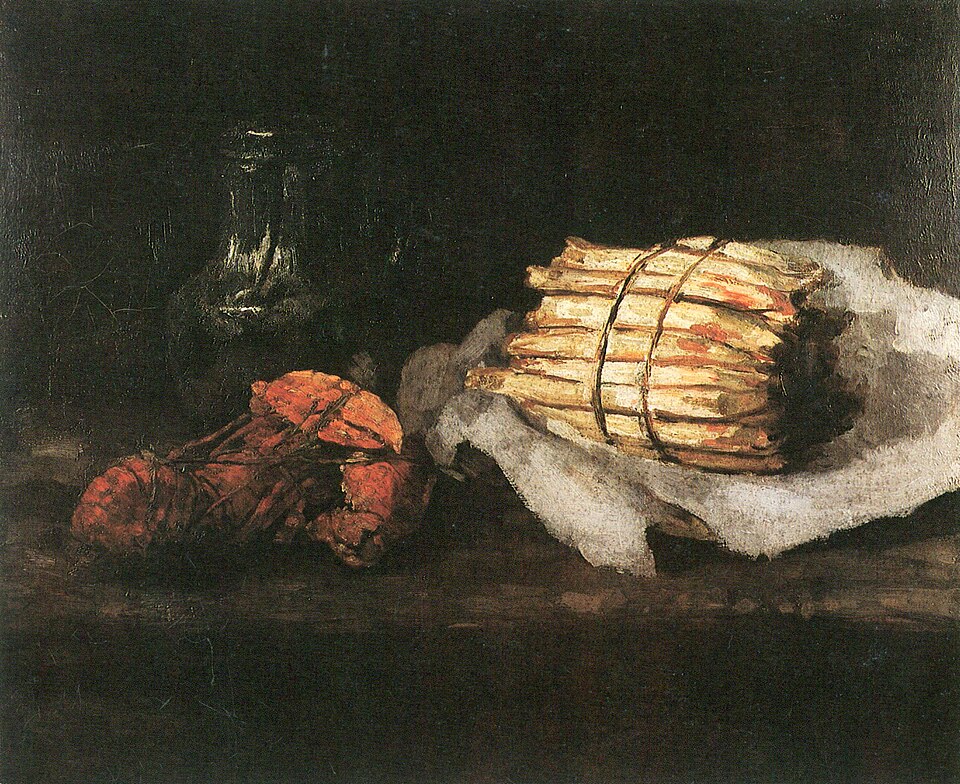
What is moving in Schuch is not brilliance in the theatrical sense. It is seriousness. His paintings seem to have been made by someone who did not want to impress the world too quickly. A still life is never just an arrangement. It is a test of truth. An apple becomes weight. A white cloth becomes light. A glass becomes air held for a moment. The surface is dense, but not heavy; quiet, but never empty.
There is a particular loneliness in this kind of painting. Not the loneliness of isolation, but the loneliness of concentration. Schuch does not seduce the viewer with charm. He builds slowly, almost stubbornly, until the image begins to breathe. One feels that he was less interested in making a beautiful picture than in finding the exact temperature of seeing.
This may be why his work feels unexpectedly close to us now. Contemporary life produces images faster than we can understand them. Schuch belongs to another rhythm. He reminds us that painting once demanded time not only from the artist, but also from the viewer. To look at him properly is to accept delay.
The exhibition’s dialogue with French painting is important, but the deeper dialogue is between ambition and humility. Schuch knew the great painters of his time. He studied them. He admired them. But his best works do not sound like echoes. They are quieter than influence. They are made from the private labour of looking again and again until a motif stops being a motif and becomes a necessity.
His landscapes have the same inwardness. Nature is not presented as spectacle. There is no grand view, no heroic horizon. Instead, the world appears in muted pressure: trees, stones, water, weather, distance. The landscape is not opened for possession. It is approached with caution, almost with respect.
That is the beauty of Schuch. He does not conquer what he paints. He stays with it. Schuch’s story is not simply about being forgotten. It is about what remains when fame is removed from the picture.
What remains is painting.
And perhaps that is enough. A fruit on a table. A dark forest. A white cloth catching light. A colour that does not shout, but stays.
Schuch teaches us that art history is not only made by those who become symbols. It is also made by those who quietly deepen the language of seeing.